Newsletter Subscribe
Enter your email address below and subscribe to our newsletter
Enter your email address below and subscribe to our newsletter


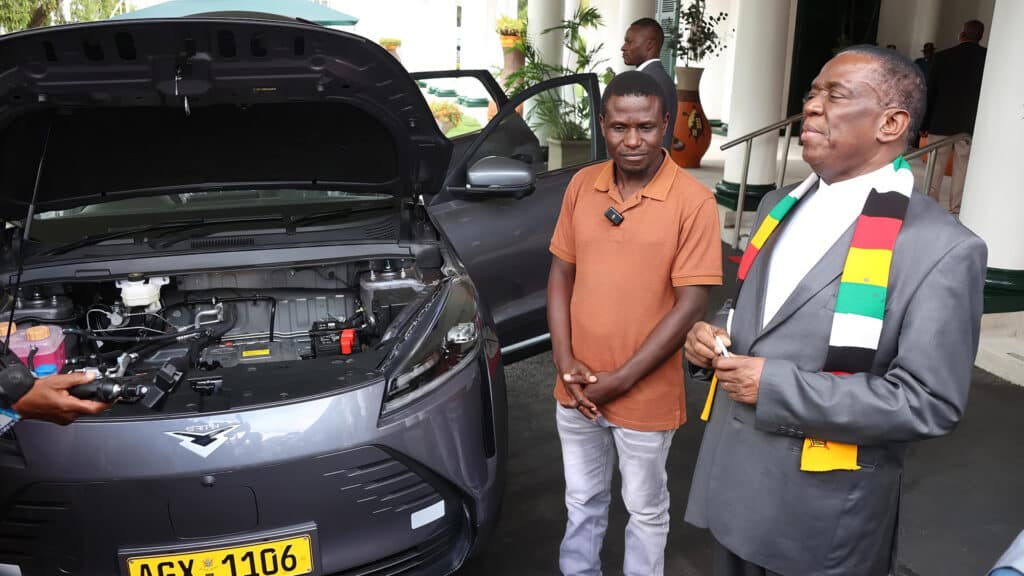
Zimbabwean innovator Maxwell Chikumbutso unveils the world’s first self-powering electric vehicle, challenging EV norms with radio wave energy technology.
 Tumisang Bogwasi Tumisang Bogwasi
Zimbabwean inventor Maxwell Chikumbutso, of Saith Group, has introduced what could be one of the most revolutionary advancements in electric vehicle (EV) technology—a self-powering electric vehicle (SPEV) that operates entirely on radio waves.
This unprecedented innovation challenges conventional physics and the traditional limitations of battery-powered EVs, potentially redefining the future of sustainable transportation.
In a recent demonstration at the State House in Harare, Chikumbutso showcased the vehicle to President Emmerson Mnangagwa, highlighting its ability to generate continuous energy without external charging. His innovation extends beyond cars to motorbikes, drones, and home energy solutions, presenting an ambitious technological breakthrough that could disrupt the global automotive industry.
Chikumbutso claims his self-powering EV harnesses energy from radio waves, a concept that has long been debated in the scientific community. The traditional laws of thermodynamics suggest that energy cannot be created from nothing, which is why many experts remain skeptical of this development.
However, Chikumbutso asserts that his invention is based on a proprietary energy system that allows the vehicle’s battery to continuously recharge itself, making external power sources obsolete.
“This vehicle is powered entirely by radio waves and violates the known laws of energy in thermodynamics,” Chikumbutso stated.
Key Technical Specifications:
The global EV market, led by companies like Tesla, Rivian, and BYD, is heavily reliant on lithium-ion batteries, which require expensive and environmentally damaging mining operations. If Chikumbutso’s technology proves viable at scale, it could:
While Chikumbutso’s invention is generating excitement, it has also sparked controversy. He claims that when attempting to patent his technology in the United States, authorities rejected his application on the grounds that it violated the natural laws of physics.
“They wanted to arrest me for changing physics,” Chikumbutso alleged.
Similar challenges have been faced by other breakthrough energy innovators, with many scientists and investors requiring rigorous independent verification before accepting such claims.
Chikumbutso’s decision to reject U.S. investment and establish his operations in Zimbabwe aligns with President Mnangagwa’s push for local innovation and industrialization. The Zimbabwean government has publicly supported his initiatives, highlighting the importance of retaining intellectual property within Africa.
“Zimbabweans are capable of spearheading game-changing, first-of-a-kind innovations that challenge the world’s traditional ways of doing things,” said President Mnangagwa.
Chikumbutso has partnered with a Chinese firm to establish a production facility in Zimbabwe that will manufacture and distribute his self-powering EVs. This strategic alliance could position Zimbabwe as a leader in alternative EV technology, bringing much-needed investment and job creation to the region.
While Chikumbutso’s invention presents a revolutionary breakthrough, several critical steps need to be taken for mass adoption:
Maxwell Chikumbutso’s self-powering electric vehicle is one of the most intriguing and controversial innovations in modern energy technology. If validated and successfully commercialized, it could:
While skepticism remains high, Chikumbutso’s bold vision and unwavering commitment to his invention could mark a significant turning point in the global pursuit of sustainable energy.
For more updates on this groundbreaking innovation, watch Chikumbutso’s full demonstration on YouTube.