Newsletter Subscribe
Enter your email address below and subscribe to our newsletter
Enter your email address below and subscribe to our newsletter


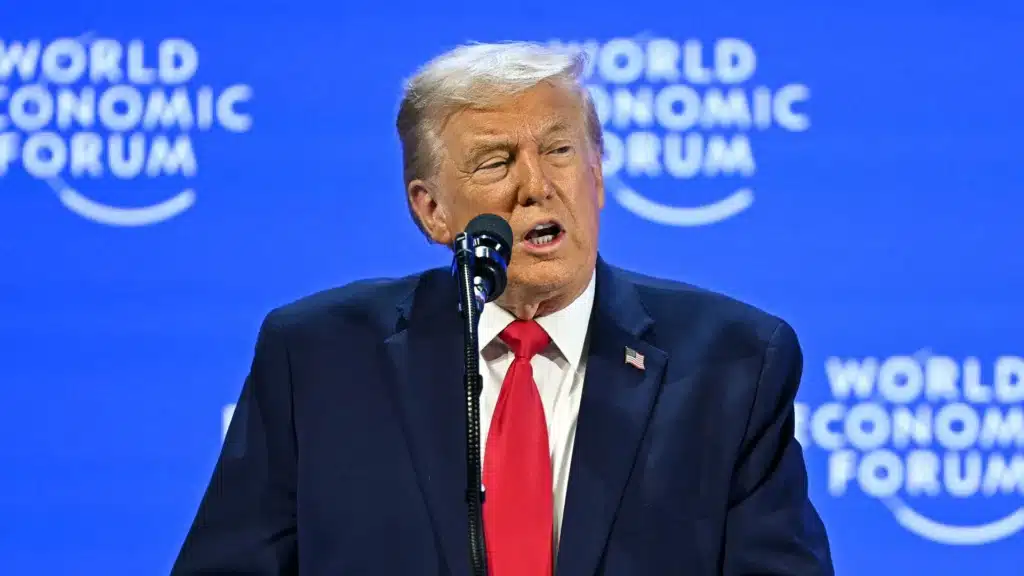
Trump used Davos 2026 to assert U.S. economic primacy and redefine alliance expectations in a fragmented global order.
 Tumisang Bogwasi Tumisang Bogwasi
U.S. President Donald J. Trump delivered a consequential address at the World Economic Forum (WEF) 2026 in Davos, outlining a sweeping agenda that blended foreign policy, economic performance, alliance dynamics, and U.S. global strategy.
The speech stood out not just for its length, but for its tone. Trump used one of the world’s most influential business platforms to assert American economic primacy, challenge European allies, and reframe geopolitics as a transactional contest tied directly to trade, security, and industrial power.
For executives, investors, and policymakers, the address offered clear signals about how Washington intends to operate in a more fragmented global order.
One of the most interesting moments of the address centered on Greenland.
Trump reiterated that the territory’s strategic value (spanning Arctic security, shipping routes, and critical minerals) makes it too important for the U.S. to ignore. While ruling out military force, he framed Greenland as a matter of long‑term security and economic positioning, not diplomacy alone.
Trump used Davos to sharpen his long‑standing critique of NATO.
He argued that alliance credibility depends on measurable contributions, particularly defense spending and industrial capacity. The message to Europe was blunt: political alignment without economic and military delivery is no longer sufficient.
For global businesses, this raises the probability that defense spending, industrial policy, and alliance politics will increasingly intersect.
Trump’s remarks also took aim at European leadership, implicitly challenging French President Emmanuel Macron’s push for strategic autonomy.
From Washington’s perspective, autonomy without scale risks fragmentation. The speech suggested growing U.S. skepticism toward European policy frameworks that rely on U.S. security guarantees while diverging on trade and industrial policy.
Trump referenced Venezuela as part of a broader narrative on restoring American strength.
While details were limited, the inclusion of Venezuela signaled a willingness to pair economic pressure with decisive action, reinforcing the idea that U.S. foreign policy is once again being tightly coupled with national security and market access.
A substantial portion of the speech focused on U.S. economic performance.
Trump highlighted:
These achievements were presented not as domestic successes alone, but as leverage in global negotiations.
Markets responded cautiously.
European equities softened as investors assessed the implications of renewed transatlantic friction, while U.S. markets reflected heightened geopolitical risk premiums. The speech reinforced the idea that policy tone can move markets even before policy action.
Traditionally a venue for consensus‑building, Davos under Trump became a stage for strategic assertion.
The address illustrated how global economic forums are evolving — less about alignment, more about signaling priorities and red lines to markets and governments alike.
Trump’s WEF 2026 speech underscored a broader shift in global governance.
Alliances are being reframed as performance‑based arrangements. Economic strength is treated as geopolitical capital. For businesses operating across borders, the takeaway is clear: geopolitics is now a core business variable, not a background risk.