Newsletter Subscribe
Enter your email address below and subscribe to our newsletter
Enter your email address below and subscribe to our newsletter


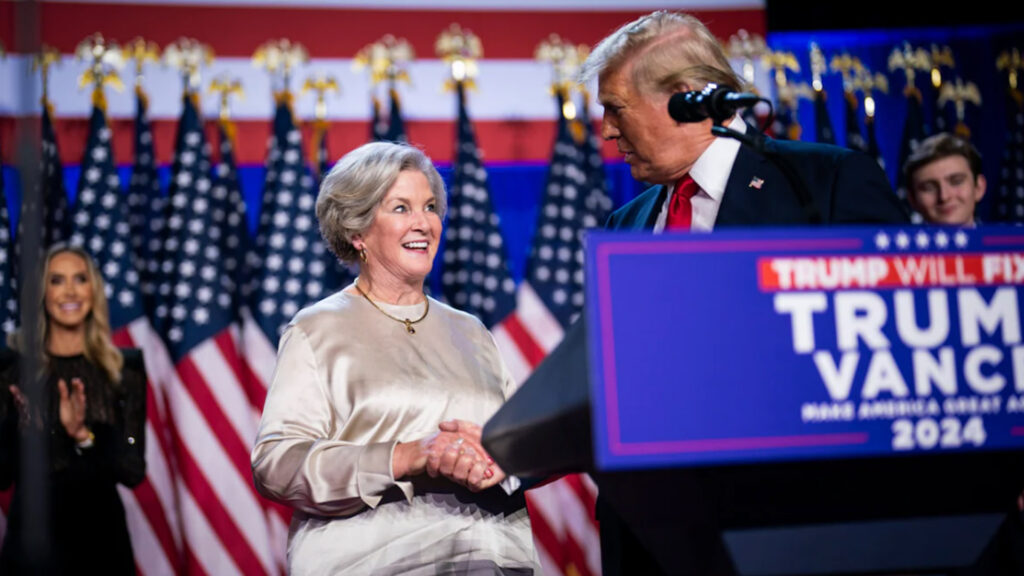
President-elect Trump appoints Susie Wiles as the first female White House Chief of Staff, a strategic move to ensure a cohesive administration.
 Tumisang Bogwasi Tumisang Bogwasi
In the wake of a historic election victory, President-elect Donald Trump has named Susie Wiles as his White House Chief of Staff, making her the first woman to hold this influential role.
Wiles, a seasoned Republican strategist, is widely credited with running one of Trump’s most organized and effective campaigns, positioning herself as a natural choice for this critical position. Her appointment marks the beginning of Trump’s new term, with high expectations for a cohesive administration that can effectively tackle the challenges ahead.
Wiles has a long-standing history with Trump, having managed his Florida campaigns in both 2016 and 2020. Known for her ability to handle high-pressure situations and navigate Trump’s personality, she was able to gain his respect by presenting hard truths while maintaining his trust.
Her pragmatic and loyal approach has earned her admiration from within and outside Trump’s circle, positioning her as the ideal candidate to manage the President-elect’s second administration.
Trump himself praised her in a statement, saying, “Susie is tough, smart, innovative, and is universally admired and respected. Susie will continue to work tirelessly to Make America Great Again. It is a well-deserved honor to have Susie as the first-ever female Chief of Staff in United States history.”
Unlike the tumultuous transitions and rapid personnel changes during Trump’s first term, Wiles’ appointment suggests a more strategic approach this time.
In 2016, Trump’s White House saw high turnover and factional infighting, largely attributed to a lack of cohesion and experience within the administration. Many experts believe that Wiles’ disciplined and structured approach could prevent similar issues from emerging in Trump’s second term.

Chris LaCivita, who served alongside Wiles on Trump’s campaign, describes her as someone who is “inclusive in conversations, seeks input from others, and is steadfastly loyal.”
Her ability to manage complex situations and personalities has been instrumental in earning her Trump’s trust. “She can manage really any ego that comes her way,” LaCivita noted, highlighting her straightforward, detail-oriented approach.
As Chief of Staff, Wiles will have a significant influence on the administration’s success. Her responsibilities include:
Political analyst Chris Whipple, author of The Gatekeepers, emphasizes the importance of the role, noting, “At the end of the day, the most important thing is telling the president what he doesn’t want to hear.”
Wiles’ unique ability to communicate with Trump openly and effectively makes her well-suited for this demanding position.
The appointment of Susie Wiles as Chief of Staff is likely to shape the direction of Trump’s administration in several ways:
Trump’s selection of Wiles indicates a shift towards a more mature and structured approach to governance. Her ability to guide Trump’s decision-making while supporting his core values could play a pivotal role in defining his second term. Unlike the factionalized administration seen during his first presidency, Trump’s new team—under Wiles’ leadership—appears poised to deliver a more unified and cohesive strategy.
The stakes are high, as Trump has openly acknowledged the importance of selecting “the best people” this time around. Wiles’ strategic approach, combined with her deep understanding of Trump’s leadership style, may help the administration avoid the missteps of the past and achieve its policy objectives effectively.
Susie Wiles’ appointment as White House Chief of Staff is a defining moment for Trump’s incoming administration. Her disciplined approach could pave the way for a more stable and effective White House.
As businesses and political observers anticipate the next steps, Wiles’ leadership will be critical in shaping both domestic and international policies that impact the U.S. economy and global relations.