Enter your email address below and subscribe to our newsletter

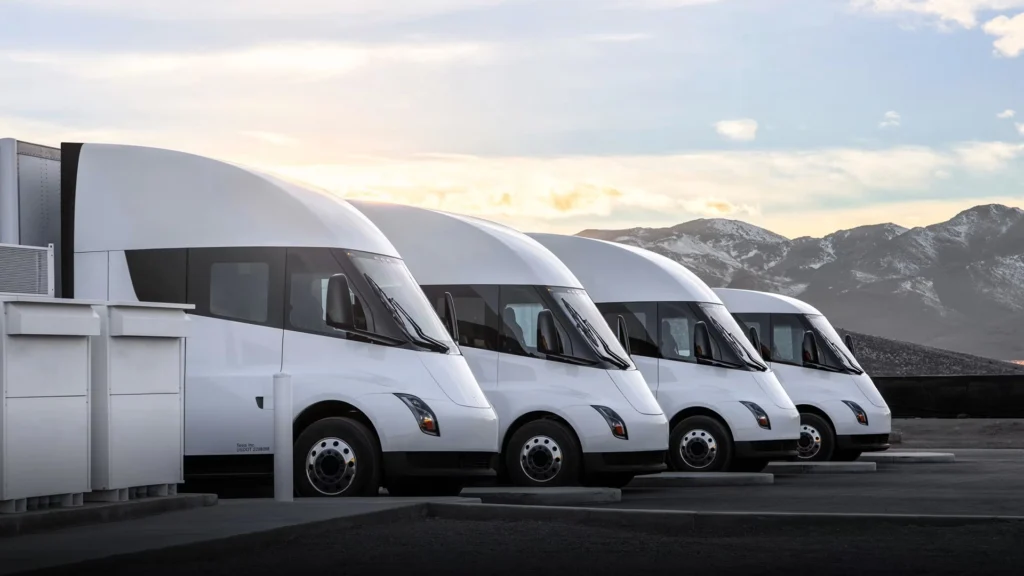
A row of white tesla semi electric trucks parked at a charging station with mountains in the background at sunset

The Tesla Semi 2026 Update: The Future of Freight Is Taking Shape

Tesla’s 2026 update for the Semi introduces new breakthroughs in range, charging, and autonomy, accelerating the shift toward electric, intelligent freight systems worldwide.

Written By: author avatar Tumisang Bogwasi
author avatar Tumisang Bogwasi
Tumisang Bogwasi, Founder & CEO of Brimco. 2X Award-Winning Entrepreneur. It all started with a popsicle stand.

Share your love

Tesla has released its highly anticipated 2026 update on the Tesla Semi, signaling a transformative shift in global freight logistics. With improvements in battery efficiency, charging infrastructure, autonomy, and cost-per-mile economics, Tesla’s latest Semi roadmap positions the company to disrupt one of the world’s most essential and carbon-intensive industries: long‑haul trucking.

For business leaders, fleet operators, and policymakers, the 2026 update provides valuable insights into where the freight market is heading and what companies must prepare for as the era of electric, autonomous logistics accelerates.

Highlights

  • Tesla Semi receives major 2026 upgrades in battery lifespan, range, software, and charging systems.
  • Megacharger network expansion accelerates across North America.
  • New autonomous‑ready features signal Tesla’s push into self‑driving freight.
  • Significant improvements in cost-per-mile efficiency vs diesel competitors.
  • Tesla scales manufacturing capacity as major logistics firms place new orders.

The 2026 Battery & Range Breakthrough

The Tesla Semi’s 2026 update brings a substantial leap in efficiency.

Key battery advancements:

  • improved energy density,
  • optimized thermal management system,
  • extended battery lifespan for fleet durability,
  • enhanced regenerative braking for heavy-load cycles.

Range improvement now allows:

  • ~500–600 miles per charge under real‑world freight conditions,
  • better performance on elevation‑heavy routes,
  • reduced charge downtime for operators.

These updates make the Semi far more competitive for long‑haul applications.

Scaling the Megacharger Network

Tesla is accelerating its rollout of high‑capacity Megacharger stations.

The 2026 plan includes:

  • multi‑megawatt charging hubs for fleet depots,
  • strategic placement along major logistics corridors,
  • integrated solar + battery storage for grid support,
  • reduced charging time for long‑haul cycles.

The goal: create a nationwide freight‑optimized charging ecosystem that mirrors the success of Tesla’s Supercharger network.

A row of tesla supercharger stations with red and white housings and charging cables the tesla logo visible in the foreground and additional chargers receding into the background
Tesla Supercharger stations lined up at a charging site highlighting the companys fast charging infrastructure for electric vehicles

Autonomous‑Ready Capabilities

The 2026 Semi update includes expanded hardware and software enabling future autonomy.

Key features:

  • upgraded sensor stack (cameras, radar, lidar‑compatible design),
  • improved compute system for autonomous driving algorithms,
  • lane‑keeping and adaptive convoy modes,
  • Tesla‑to‑Tesla platooning capability for multi‑vehicle fleets.

These upgrades position the Semi as a future‑proof freight platform ready to incorporate Full Self‑Driving (FSD) once regulation allows.

Cost Competitiveness: The Diesel Disruption

Tesla claims the updated Semi can reduce cost-per‑mile by 30–50% compared to diesel.

Savings come from:

  • electricity cost vs diesel fuel,
  • reduced maintenance,
  • regenerative braking,
  • improved fleet uptime,
  • longer vehicle lifespan.

For large fleet operators, these economics could reshape procurement strategies.

Manufacturing Scale-Up & Market Adoption

The 2026 update also confirms that Tesla is expanding Semi production capacity.

Large logistics adopters include:

  • PepsiCo,
  • Walmart,
  • UPS,
  • FedEx (pilot programs),
  • dedicated regional freight carriers.

This traction demonstrates growing confidence in electric heavy‑duty trucking.

Three blue tesla semi electric trucks branded with the pepsi logo are parked side by side at a distribution facility highlighting pepsis shift toward zero emission freight transport
Three blue Tesla Semi electric trucks branded with the Pepsi logo are parked side by side at a distribution facility highlighting Pepsis shift toward zero emission freight transport

Industry Challenges: What Tesla Must Overcome

Despite progress, challenges remain:

  • high upfront vehicle cost,
  • limited global Megacharger network,
  • grid constraints for high‑capacity charging,
  • regulatory lag on autonomous approvals,
  • competition from Daimler, Volvo, Nikola, and BYD.

Still, Tesla’s integrated approach (combining vehicles, batteries, software, and charging) gives it a competitive edge.

Outlook: The Future of Freight Is Electric, Intelligent, and Autonomous

The Tesla Semi 2026 update proves that the company is not simply building a truck, it is building the future architecture of global logistics.

With advancements in range, charging, autonomy, and operational economics, Tesla continues to position the Semi as the cornerstone of next-generation freight.

The road to widespread adoption will require infrastructure expansion and policy support, but the direction is clear: electric freight is inevitable, and Tesla wants to lead it.

Tumisang Bogwasi
Tumisang Bogwasi

Tumisang Bogwasi, Founder & CEO of Brimco. 2X Award-Winning Entrepreneur. It all started with a popsicle stand.