Newsletter Subscribe
Enter your email address below and subscribe to our newsletter
Enter your email address below and subscribe to our newsletter


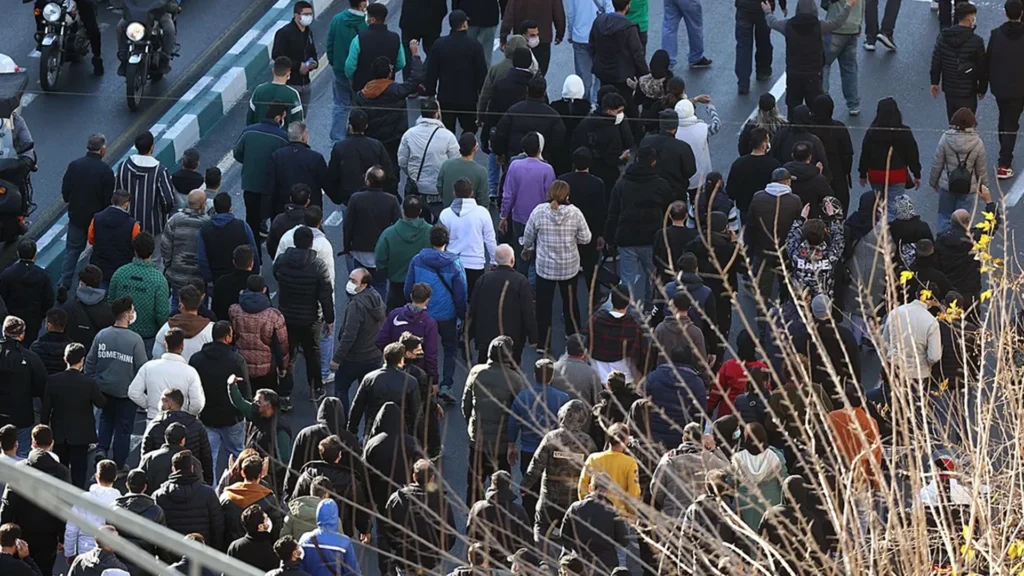
Rising inflation and corruption are fueling protests in Iran, highlighting deep economic strain and weakening public trust.
 Tumisang Bogwasi Tumisang Bogwasi
Street protests have erupted across parts of Iran, driven by rising inflation, persistent currency weakness, and deepening public anger over corruption. While demonstrations are not new to the Islamic Republic, the timing, spread, and tone of the current unrest point to a familiar but increasingly dangerous combination: economic pressure meeting political rigidity.
Iran is entering another period where economic stress is no longer abstract or manageable through short-term relief. Instead, it is directly affecting daily life, household security, and long-term prospects, especially for younger and urban populations.
Iran is currently facing one of the most severe inflationary episodes in its modern history.
By late November 2025, average annual inflation stood at 42.2%, while point-to-point inflation surged to 52.6% in late December. The Iranian rial collapsed to a record 1.42 million rials per US dollar, having lost nearly half its value in 2025 alone.
This currency collapse has dramatically increased import costs, distorted pricing, and eroded wages faster than households can adapt. Inflation is no longer a background condition, it is the dominant force shaping daily economic life.
Iran’s inflation problem has become chronic rather than cyclical.
Prices for essentials (especially food) have surged far faster than headline inflation. Year-on-year prices for food, beverages, and tobacco jumped by roughly 72% in December 2025, making food inflation the most immediate and politically explosive driver of unrest.
For many households, food has shifted from a manageable expense to a survival calculation, turning economic frustration into street-level anger. The Iranian rial’s prolonged weakness has amplified the pain, particularly for wage earners, pensioners, and the urban middle class who lack access to hard-currency income or informal hedges.
Inflation in Iran is not just an economic statistic debated by economists; it is a daily lived experience that shapes how families plan, save, and survive. When inflation becomes persistent, it also becomes political.
Economic pain in Iran is amplified by how inflation is distributed.
Iran’s multi-tiered exchange‑rate system (with official, semi-official, and free‑market rates) has become a focal point of public anger. Access to cheaper dollars is often limited to politically connected firms and insiders, while ordinary merchants face brutal market prices.
This structure converts inflation into perceived injustice, reinforcing beliefs that corruption, not merely sanctions, is driving hardship.
Economic hardship alone does not always lead to protest.
What transforms pressure into unrest is the widespread perception that:
Protest slogans increasingly target systemic corruption and governance failures rather than isolated policies. This reflects a deeper erosion of trust, not just in economic management, but in institutions themselves.
Iran’s economy remains heavily constrained by international sanctions and financial isolation.
These restrictions:
While sanctions are not the sole cause of Iran’s economic woes, they magnify existing structural weaknesses. Reduced state revenue narrows policy options, forces reliance on monetary expansion, and feeds inflationary pressure.
Iran’s demographic profile adds urgency to the unrest.
A young, educated population faces:
This generation is more connected, more aware of global living standards, and less patient with stagnation. The widening gap between expectations and reality provides sustained energy for protest movements.
Iran sits at the crossroads of critical energy, security, and geopolitical dynamics.
Domestic instability can influence:
Markets watch Iran not for the size of its economy, but for its strategic weight and its ability to trigger wider regional reactions.
Facing mounting protests, President Masoud Pezeshkian’s administration has moved to signal accountability.
Key steps include:
While these moves aim to restore confidence, critics argue that personnel changes alone cannot resolve structural constraints imposed by sanctions, fiscal exhaustion, and prolonged monetary financing.

Iranian authorities typically respond to unrest with a familiar toolkit:
While these measures can suppress immediate escalation, they rarely resolve underlying drivers. Without credible structural reform, responses tend to manage symptoms rather than causes, buying time rather than restoring confidence.
For businesses, Iran remains a high-risk operating environment.
Key concerns include:
Even companies indirectly exposed to Iran (through regional trade or energy markets) feel the spillover effects. Risk pricing increasingly reflects political as well as economic uncertainty.
What distinguishes these ongoing protests is who is protesting.
Demonstrations began in Tehran’s Grand Bazaar and spread to Isfahan, Shiraz, Mashhad, and Yazd. Historically, bazaar‑led mobilisation has signaled systemic crisis, from the Constitutional Revolution to the fall of the Shah.
Merchants sit at the heart of trade, credit, and price formation. When they protest, it reflects not ideology but a breakdown of contracts, pricing, and trust.
This protest wave differs from prior episodes. The unrest of 2019 centered on fuel prices; 2022 was driven by social freedoms and youth mobilisation. 2025 is led by the commercial middle class, the group most dependent on monetary stability and historically central to regime legitimacy.
Iran’s protests follow a pattern seen in multiple economies under sustained strain.
When inflation rises faster than incomes, institutions lose credibility, and reform pathways appear blocked, social stability weakens. In such environments, unrest becomes cyclical rather than exceptional.
Iran’s protests are not revolutionary, yet. But they are increasingly systemic.
As informal dollarisation spreads (with rents, appliances, and wholesale food contracts priced in dollars or gold) the rial is losing its role as a unit of account, store of value, and social contract.
Without credible reform of exchange rates, fiscal discipline, and external economic channels, pressure will continue to resurface. History suggests that revolutions do not begin when people are angry, they begin when prices stop making sense.
In Iran today, that threshold has already been crossed.
The current protests may eventually subside, but the underlying pressures remain unresolved.
Until inflation is brought under control, corruption credibly addressed, and economic opportunity expanded, Iran is likely to experience repeated episodes of unrest. For the global community, the situation underscores a hard truth: economic fundamentals and political legitimacy are inseparable, and when both erode, stability becomes fragile.