Newsletter Subscribe
Enter your email address below and subscribe to our newsletter
Enter your email address below and subscribe to our newsletter


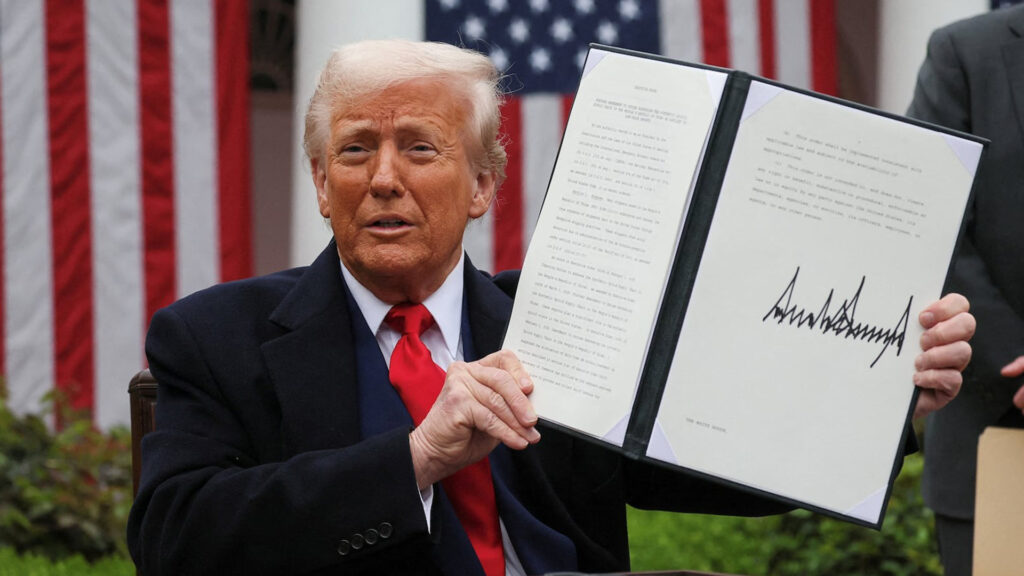
President Trump’s April 2, 2025, executive order enacts a reciprocal tariff policy to address trade deficits and restore American manufacturing.
 Tumisang Bogwasi Tumisang Bogwasi
On April 2, 2025, U.S. President Donald J. Trump signed an executive order titled Regulating Imports with a Reciprocal Tariff to Rectify Trade Practices that Contribute to Large and Persistent Annual United States Goods Trade Deficits.
The directive invokes sweeping powers under the International Emergency Economic Powers Act (IEEPA), the National Emergencies Act (NEA), and other statutes to declare a national emergency over the structural asymmetries and non-reciprocal trade practices that have led to the hollowing out of America’s manufacturing and industrial base.
Framed by the President as a defining policy of the new administration, this order seeks to reverse a decades-long decline in domestic production, address vulnerabilities in supply chains, and restore national security by scaling U.S. manufacturing capacity.
The post-war international trade system, centered around the General Agreement on Tariffs and Trade (GATT) and later the World Trade Organization (WTO), was built on the assumption that American liberalization would lead others to follow. However, President Trump asserts that this model failed to secure reciprocity, resulting in America holding one of the world’s lowest average MFN tariff rates (3.3%), compared to trading partners such as India (17%), Brazil (11.2%), and China (7.5%).
The President highlights how non-tariff barriers—including regulatory discrimination, IP theft, and suppressed domestic consumption—have skewed global trade against U.S. interests. For example:
This discrepancy creates structural disadvantages for American producers while enabling foreign competitors to scale, innovate, and dominate international markets.
President Trump’s executive order positions manufacturing as a cornerstone of national defense. The lack of domestic production capacity poses security risks from military readiness to pharmaceutical independence. The COVID-19 pandemic, attacks on global shipping routes, and increasing geopolitical tensions have all exposed the fragility of relying on foreign supply chains.
The order reinforces prior trade doctrines such as Presidential Policy Directive 21 and recognizes sectors like food and agriculture as critical infrastructure.
As manufacturing dropped from 28.4% of global share in 2001 to 17.4% in 2023, the U.S. also lost 5 million manufacturing jobs between 1997 and 2024. The current 11% share of GDP from manufacturing still powers 60% of exports and 35% of productivity growth, illustrating its economic multiplier effect.
Domestic production underpins:
While the move may face criticism for triggering trade disputes or inflating import prices, its long-term objective is economic independence. The order champions positive reciprocity over protectionism, seeking equitable treatment for U.S. goods abroad while incentivizing allies to align with shared economic values.
This action reaffirms that economic strength is national strength—especially as the global balance of power shifts.
In declaring April 2, 2025, a Liberation Day of economic sovereignty, President Trump offers a new paradigm: One where America’s competitiveness is restored through reciprocal trade, innovation, and production at home.