Newsletter Subscribe
Enter your email address below and subscribe to our newsletter
Enter your email address below and subscribe to our newsletter


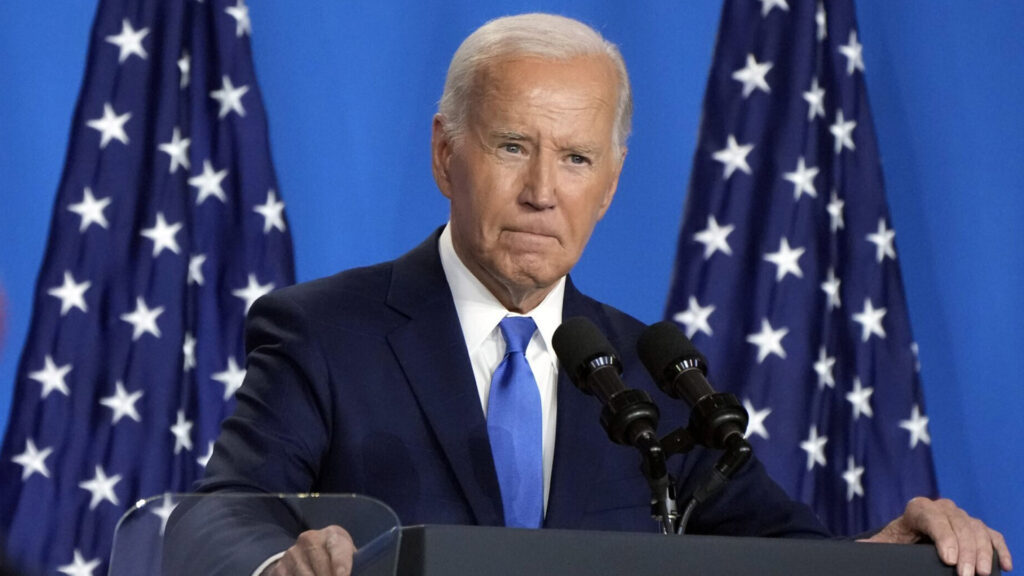
US President Joe Biden withdraws from the 2024 race, endorsing VP Kamala Harris, shaking up the election landscape. Read more on the implications.
 Tumisang Bogwasi Tumisang Bogwasi
In a seismic shift in US politics and global affairs that has sent shockwaves through the political landscape, US President Joe Biden has announced his decision to abandon his re-election bid for the 2024 presidential race.
This unprecedented move, coming less than four months before the election, has not only thrown the Democratic party into a state of flux but also introduced a new level of uncertainty into global affairs and financial markets.
President Biden’s decision to step aside comes after weeks of intense debate within the Democratic party about his candidacy.
A disastrous debate performance against Donald Trump had reignited concerns about the 81-year-old president’s mental acuity and significantly damaged his standing among American voters.
An Associated Press poll released last week found that nearly two-thirds of Democratic voters believed Biden should drop out of the race.
In his statement, Biden emphasized that while it had been his intention to seek re-election, he believed it was “in the best interest of my party and the country for me to stand down.”
This decision marks the end of one of Washington’s most storied political careers, spanning from his entry into the Senate in 1973 to his current role as the 46th President of the United States.
With Biden’s endorsement, Vice President Kamala Harris emerges as the frontrunner for the Democratic nomination. If successful, Harris would become the first female president in US history.
Her candidacy has quickly garnered support from influential Democrats, including former president Bill Clinton and former Secretary of State Hillary Clinton.
However, the path forward is not without challenges. The Democratic party will need to rally behind their new candidate in the weeks leading up to the official nominating convention on August 19.
Democratic National Committee chair Jaime Harrison has promised to lay out the “next steps and the path forward for the nomination process” in short order.
Biden’s unprecedented decision is likely to reverberate globally, injecting new uncertainty into US policy during acute geopolitical tension.
From the Indo-Pacific region to Ukraine and the Middle East, international leaders and policymakers will be closely watching the transition of power within the Democratic party and its potential impact on US foreign policy.
Financial markets, which have already been grappling with inflation concerns and geopolitical instability, may experience increased volatility in the wake of this announcement.
Investors and business leaders will be keenly observing how Harris or any potential Democratic nominee might approach economic policies, trade relations, and regulatory frameworks.
The Republican party has wasted no time in capitalizing on Biden’s decision. Donald Trump, the likely Republican nominee, stated that Biden was “not fit to run for president” and “certainly not fit to serve.”
More dramatically, Republican Speaker of the House Mike Johnson has called for Biden’s immediate resignation from the presidency, arguing that if Biden is not fit to run, he is not fit to serve.
As the dust settles on this political earthquake, several key questions remain:
The coming weeks will be crucial as the Democratic party attempts to regroup and present a united front heading into the November election. With democracy itself seemingly at stake, according to many Democratic leaders, the pressure to select a strong, electable candidate has never been higher.