Newsletter Subscribe
Enter your email address below and subscribe to our newsletter
Enter your email address below and subscribe to our newsletter


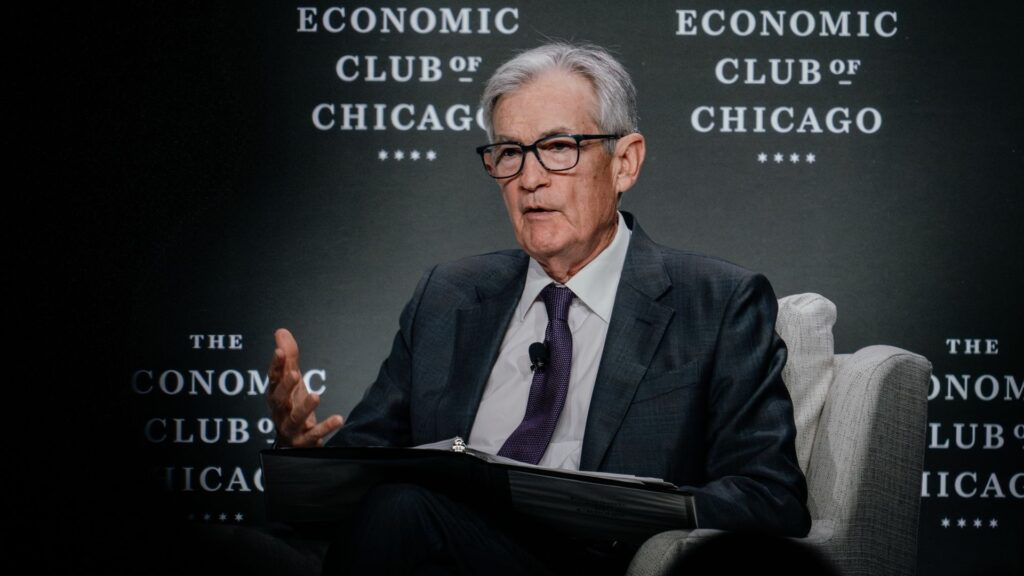
Powell's remarks raise questions about Fed independence, inflation risks, and his future at the helm.
 Tumisang Bogwasi Tumisang Bogwasi
At the Economic Club of Chicago, Federal Reserve Chair Jerome Powell delivered a wide-ranging assessment of the U.S. economy. But instead of clarity, Powell’s remarks raised serious concerns about the Federal Reserve’s approach under his leadership.
From resisting rate cuts despite falling inflation to venturing into political commentary on trade policy, Powell’s performance revealed a Fed increasingly out of step with both economic data and global monetary trends.
Powell acknowledged that the recently announced tariffs are “significantly larger than anticipated,” and warned of both inflation and uncertainty. But critics argue his remarks were less about economic stewardship and more about political signaling.
Rather than adjust monetary policy in light of these shocks, Powell chose to lecture on trade—a domain well outside the Fed’s mandate.
This drew backlash from fiscal conservatives and pro-growth economists who believe the Fed should facilitate, not frustrate, pro-industry economic policy. As global central banks ease, Powell’s hesitation threatens U.S. competitiveness.
Despite core PCE inflation tracking near 2.6%, Powell defended the decision to hold rates high. This came as Europe cut interest rates and commodity prices softened.
“There is no economic justification for keeping rates this high while the rest of the world pivots,” noted E.J. Antoni of the Heritage Foundation. “It’s clear Powell is prioritizing politics over price stability.”
Meanwhile, supply chain disruptions driven by tariffs—usually considered a fiscal issue—were described by Powell as long-term risks to growth and inflation.
Powell’s comments on tariffs, especially his insinuation that new trade policies could backfire economically, were viewed by many as overtly political. His critiques echoed talking points found more often on op-ed pages than in central bank communiqués.
“He’s not just forecasting policy outcomes, he’s editorializing against them,” said former World Bank President David Malpass. “That’s not the job of a central banker.”

Powell admitted that falling immigration is stalling labor force growth. Still, he described the labor market as “broadly in balance.” Critics argue that this assessment downplays the real risks posed by declining immigration and public sector downsizing.
With former President Trump openly criticizing Powell’s performance and questioning his judgment, Powell attempted to draw a hard line on independence:
“Our decisions are made based on data, not politics.”
Yet Powell’s persistent commentary on trade and fiscal strategy contradicts this claim. His refusal to lower interest rates—even as economic indicators soften—has led many to ask whether the Fed has become an unelected political actor.
Powell acknowledged U.S. debt levels are “unsustainable” and that entitlement spending must be addressed. But by maintaining a tight policy during declining growth, critics say he risks compounding the fiscal strain rather than alleviating it.
Powell reaffirmed the strength of the U.S. banking system but warned about commercial real estate exposure and the explosive growth in private credit.
His response? More monitoring, not more action—another example of the Fed’s reactive, rather than proactive, stance.
On innovation, Powell was more measured. He expressed openness to stablecoin regulation and maintained support for dollar swap lines. His comments on AI struck a balance between optimism and caution, labeling it one of the “most impactful forces in the global economy.”
Jerome Powell’s Chicago speech will be remembered not for its insight but for its evasion. By dodging rate cuts, editorializing on trade policy, and projecting mixed signals on inflation, Powell may have accelerated the very uncertainty he warned about.
Whether the Fed can regain trust as a neutral arbiter of monetary policy may depend on whether Powell reins in the politics, or whether the White House reins him in first.