Enter your email address below and subscribe to our newsletter

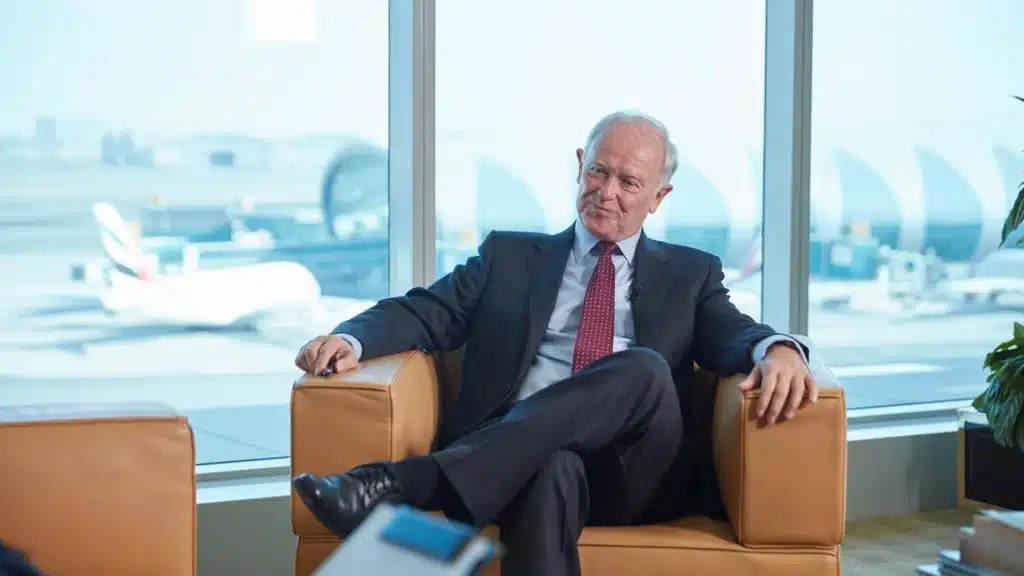
Sir tim clark president of emirates airline seated in an armchair during an interview with airport aircraft visible through large windows behind him

Emirates Airline President: Inside the Strategy Powering the World’s Most Resilient Aviation Giant

Emirates Airline President Tim Clark breaks down the future of aviation, revealing how technology, fleet upgrades, and global demand will shape Emirates’ next decade.

Written By: author avatar Tumisang Bogwasi
author avatar Tumisang Bogwasi
Tumisang Bogwasi, Founder & CEO of Brimco. 2X Award-Winning Entrepreneur. It all started with a popsicle stand.

Share your love

Emirates Airline President Sir Tim Clark remains one of the most influential figures in global aviation. His leadership has guided Emirates through oil shocks, geopolitical turbulence, pandemics, and intense competition; yet the airline continues to dominate international long‑haul travel.

In a recent interview, Clark outlined his outlook on the future of aviation, the role of technology, and how Emirates maintains world-class service while expanding aggressively in a tightening global economy.

Clark’s message was direct: the aviation industry is entering a new era of consolidation, efficiency, and technology-driven transformation, and Emirates intends to lead that shift.

Highlights

  • Emirates continues to outperform global peers in passenger numbers, network recovery, and profitability.
  • Tim Clark warns of rising operational pressures: fuel volatility, supply‑chain constraints, and regulatory complexity.
  • The airline is doubling down on fleet modernisation including the A350 and 777X.
  • Technology, AI, and automation will play an increasing role in Emirates’ operational strategy.
  • Global travel demand remains strong, but airport capacity and labour shortages threaten long‑term industry growth.

Emirates’ Post‑Pandemic Strength

While many global carriers are still recovering, Emirates has returned to near‑full capacity, supported by:

  • strategic network resilience,
  • Dubai’s position as a global transit hub,
  • strong demand for leisure and premium travel,
  • and powerful brand equity.

Passenger traffic across Dubai International Airport now exceeds pre‑pandemic levels, demonstrating the strength of the hub‑and‑spoke model.

Fleet Modernisation: The Heart of Emirates’ Strategy

Clark emphasised that fleet renewal is central to Emirates’ future competitiveness.

Incoming fleet additions:

  • Airbus A350‑900 deliveries beginning 2024/2025.
  • Boeing 777X expected to transform long-haul efficiency.
  • Cabin retrofits across the A380 and 777 fleet.

These upgrades will improve fuel efficiency, reduce emissions, and enhance passenger experience.

Sir tim clark president of emirates airline standing beside an emirates cabin crew member in the onboard lounge of an emirates a380 aircraft
Sir Tim Clark President of Emirates Airline pictured inside the onboard lounge of an Emirates A380 alongside an Emirates cabin crew member

The Role of Technology and AI in the Emirates’ Future

Tim Clark highlighted the growing reliance on technology to address aviation’s biggest challenges.

AI and automation will support:

  • predictive aircraft maintenance,
  • crew optimisation,
  • dynamic pricing and revenue management,
  • baggage handling efficiency,
  • customer‑experience personalisation.

Emirates is already deploying advanced data analytics to streamline operations across one of the world’s most complex route networks.

Global Aviation Challenges Ahead

Despite Emirates’ strength, Clark warned the industry faces structural risks:

  • fuel price volatility,
  • constrained aircraft delivery timelines,
  • geopolitical tensions impacting routes,
  • labour shortages affecting airport operations,
  • increasing environmental compliance demands.

These challenges will require airlines to operate with greater agility and financial discipline.

Competition in a Consolidating Market

While Middle Eastern carriers (Qatar Airways, Etihad, Saudia) remain strong, Emirates retains distinct competitive advantages:

  • scale of operations,
  • superior global connectivity,
  • strong financial backing from Dubai,
  • premium cabin innovation,
  • and unmatched long-haul network depth.

However, airline alliances and low-cost carriers continue to reshape global competition.

Outlook: Emirates Is Building the Airline of the Future

Tim Clark’s leadership vision is clear: Emirates will continue to reinvest in its fleet, people, hubs, and technology to stay ahead of global industry disruption.

The airline’s long-term strategy focuses on:

  • operational excellence,
  • sustainable aviation fuel adoption,
  • AI-integrated service delivery,
  • and capturing rising travel demand from India, Africa, and Southeast Asia.

As Clark noted: “The world wants to travel. Our job is to make sure we’re ready, efficient, and leading the way.”

Sir tim clark president of emirates airline standing in a modern architectural setting framed by circular structural elements
Sir Tim Clark President of Emirates Airline pictured in a contemporary architectural space that reflects the airlines design led approach to aviation

Emirates is not just surviving a volatile industry, it is shaping the next era of global aviation.

Tumisang Bogwasi
Tumisang Bogwasi

Tumisang Bogwasi, Founder & CEO of Brimco. 2X Award-Winning Entrepreneur. It all started with a popsicle stand.