Newsletter Subscribe
Enter your email address below and subscribe to our newsletter
Enter your email address below and subscribe to our newsletter


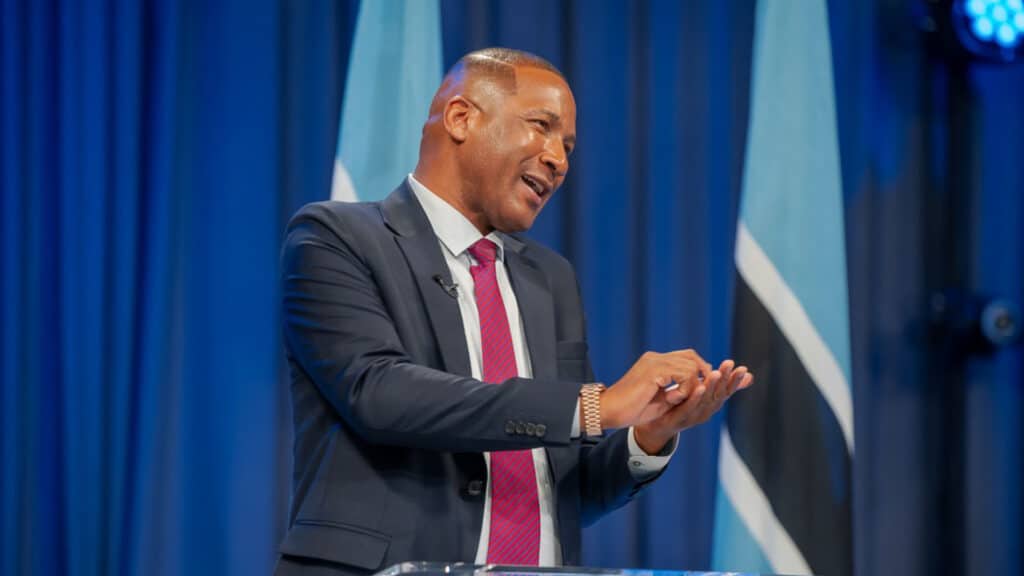
President Duma Boko’s historic address unveiled Botswana’s 10-point recovery plan, which covers digitization, infrastructure, economic justice, and procurement reform.
 Tumisang Bogwasi Tumisang Bogwasi
In a stirring and unflinchingly honest address, President Advocate Duma G. Boko delivered what is being heralded as one of the most consequential speeches in Botswana’s modern history.
Speaking directly to accounting officers during a high-level engagement, Boko pulled no punches in dissecting the roots of Botswana’s socio-economic malaise, while articulating a transformative, radical vision for national revival. His address was part performance audit, part moral exhortation, and a battle cry for institutional and ideological reinvention.
With brutal candor, Boko painted a sobering picture of Botswana’s current status. Once lauded for its stability and diamond-fueled prosperity, the nation is now, in his words, “tottering on the brink of collapse.” Despite its upper-middle-income classification and an educated population, Botswana remains plagued by underperformance, systemic inefficiencies, and growing public disillusionment.
“If we conceptualized this country as a company, it would now be a company that is to be placed under liquidation,” Boko said.
He called for collective accountability from the country’s intelligentsia and public servants, arguing that they have failed to deliver on the promise of post-independence economic progress. The critique was not merely technical—it was deeply moral.
“We must die as who we were yesterday and before to be reborn a different breed and species that now carries the agency of taking this country higher.”
While the diagnosis was widely appreciated for its honesty, critics may argue that Boko’s rhetoric risks over-emphasizing collapse without adequately recognizing areas of resilience in Botswana’s economy or civil service.
Boko’s address marked a stark ideological pivot. He launched a scathing takedown of the neoliberal economic framework that has guided Botswana’s policymaking for decades. Labeling doctrines such as the Washington Consensus and free-market orthodoxy as “absolute nonsense,” Boko argued that they had left Botswana vulnerable, dependent, and directionless.
“Don’t come to me and tell me government must not get involved in the arena of production. I don’t care from what school of economics you get it from. It doesn’t work and it will not work here.”
To supporters, this was a refreshing departure from a failed orthodoxy. However, skeptics may question whether rejecting such frameworks without a clearly defined alternative may risk policy confusion or populist overreach.
Boko introduced a ten-pronged national strategy aimed at institutional reinvention, productivity acceleration, and long-term resilience:
While comprehensive, the execution feasibility of such a wide-ranging plan within limited political and fiscal cycles remains a critical point of scrutiny.
Central to Boko’s message was a plea for a redefinition of leadership temperament in Botswana’s civil service. Bureaucrats must possess not just competence, but also emotional intelligence and the courage to make principled decisions—even at personal risk.
“Are you able to sit and listen to someone talk nonsense, even insult you, and still find the nugget of rationality? That’s temperament.”
He praised meritocratic leaders and condemned political loyalty as a metric for performance, stating unequivocally that results and integrity are the only standards that matter.
However, there remains a concern whether this culture shift can be enforced in a deeply politicized public sector without stronger institutional safeguards.
Boko took direct aim at the country’s procurement regime, calling it a “hotbed of corruption” that had become “a project in itself.” He argued that it was a key obstacle to delivery and progress.
“Three years. That’s all I have. And I’m not going to wait five years for a procurement process.”
He championed rapid execution models like the Swiss Challenge, where private sector innovation is welcomed and streamlined through fast-track competition. Boko warned that if procurement inefficiencies continued, they would become “national liabilities.”
Nevertheless, introducing such rapid models without robust oversight mechanisms could pose new risks around elite capture and transparency.
Boko criticized the opaque practices surrounding Botswana’s diamond sales, accusing state agencies of being wedded to single-channel auction systems. “The country has diamonds but no money,” he said, challenging the very logic of current export models.
He also exposed staggering inefficiencies in parastatal organizations like BPC and CMS, where procurement missteps and outdated systems have caused national embarrassment and avoidable death. His insistence was to justify one’s existence—or relinquish it.
Some may argue that the speech fell short in detailing the concrete steps to hold these institutions accountable in practice.
The president’s message was not just managerial but deeply patriotic and philosophical. He decried foreign travel excesses, lazy ministerial entourages, and the culture of ceremonial leadership.
“Stop spoon-feeding and chaperoning,” he told civil servants.
He pledged to raise $600 million in foreign investment by year-end, emphasizing lean delegations, actionable goals, and economic diplomacy. He made it clear that if public officers cannot keep up, they will be replaced.
While many praised his no-nonsense tone, others may interpret the rhetoric as overly centralized and dependent on top-down execution.
Boko’s speech may be a turning point in Botswana’s post-colonial narrative. It redefined national ambition, challenged entrenched norms, and reasserted the power of performance-driven governance. His challenge is not just administrative—it is spiritual and existential.
“We must be born again. We must cast aside everything we’ve done so far and rethink our national identity.”
For Botswana to rise, Boko believes it must abandon outdated ideologies, embrace radical experimentation, and build institutions that serve the present and future generations. Still, his bold vision will require rhetorical power, resilient systems, inclusive debate, and results-based follow-through to succeed.