Newsletter Subscribe
Enter your email address below and subscribe to our newsletter
Enter your email address below and subscribe to our newsletter


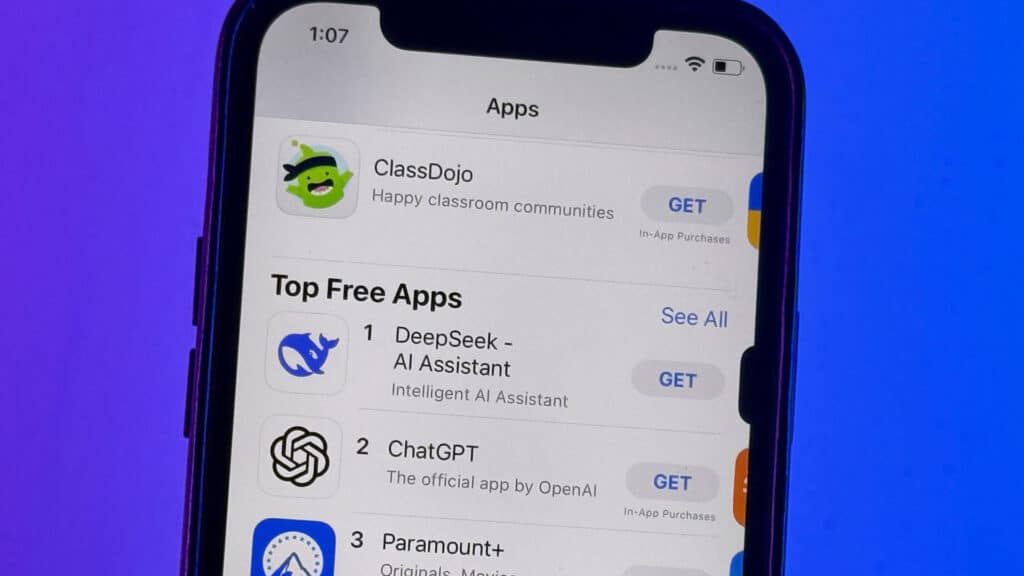
DeepSeek overtakes ChatGPT as the No. 1 AI app. What does this mean for OpenAI, Google, and the AI industry?
 Tumisang Bogwasi Tumisang Bogwasi
The AI landscape is witnessing a significant shift as DeepSeek, a Chinese AI lab, has overtaken OpenAI’s ChatGPT to become the No. 1 free app in Apple’s App Store across 51 countries, including the United States.
This rapid rise signals a disruption in the AI chatbot space, raising questions about market dynamics, AI model efficiency, and the future of dominant players like OpenAI and Google.
DeepSeek’s ability to train competitive AI models with lower-cost chips and greater efficiency has caught industry leaders off guard, forcing a reassessment of AI training economics and scalability. This disruption has been felt across the tech industry, with Nvidia’s stock price dropping by 17% and AI firms scrambling to analyze DeepSeek’s methods.
DeepSeek’s mobile app skyrocketed to No. 1 in the iOS App Store within days, moving up from No. 31 on January 24 to No. 1 by January 26. It climbed from No. 133 to No. 14 on Google Play in the same period.
This surge is unprecedented for an AI chatbot app, surpassing the growth of Perplexity, another rising AI competitor, by 300% in downloads within a week. According to Sensor Tower, over 80% of DeepSeek’s total mobile downloads occurred in just the past seven days.
Industry Insight: Apple’s App Store ranking algorithm prioritizes install velocity, engagement, and user retention over total downloads. This means DeepSeek’s explosive adoption rate played a crucial role in its rise to the top.
DeepSeek’s rapid success is attributed to its cost-efficient AI training methods, which reportedly rely on significantly less expensive chips compared to Nvidia’s high-end GPUs. This efficiency breakthrough has sent shockwaves through the AI industry, forcing competitors to reevaluate their own computing expenditures.
DeepSeek’s R1 model is already competitive with OpenAI’s GPT-4 and Google’s Gemini, despite being developed at a fraction of the cost. If these efficiency gains prove scalable, it could reshape the economics of AI model training, potentially lowering barriers to entry for AI startups.
Key Takeaway: AI labs have historically relied on high-cost computing power to train advanced models. DeepSeek’s ability to achieve comparable results with cheaper hardware suggests that AI efficiency—not just raw computing power—will determine future success.

The dominance of ChatGPT and Gemini is now under threat. Until now, OpenAI and Google have been seen as uncontested leaders in generative AI, but DeepSeek’s rapid rise has challenged their competitive position.
With millions of active users within days, DeepSeek has demonstrated that the consumer AI space is still volatile. This could pressure OpenAI, Google, and Meta to accelerate their AI advancements or lower their pricing models to stay competitive.
Tech Industry Response: Reports suggest that Meta has formed internal “war rooms” to analyze DeepSeek’s training methods and assess its implications on the broader AI race.
Nvidia, a dominant supplier of high-end AI chips, saw its stock price drop 17% on Monday in response to DeepSeek’s efficient AI model training approach.
Investors are now questioning whether costly AI training models are sustainable, given DeepSeek’s ability to achieve similar results with less powerful hardware.
Market Impact: If DeepSeek’s model proves scalable, demand for high-cost Nvidia chips may decrease, affecting the company’s dominance in AI computing.
DeepSeek’s rise could also spark geopolitical concerns in the AI space. The U.S. has implemented export restrictions on AI chips to China, aiming to slow its AI progress. However, if Chinese companies like DeepSeek achieve breakthroughs in AI efficiency, these restrictions may become less effective.
Strategic Implication: If China’s AI firms can train competitive models without relying on U.S. chips, it could redefine global AI leadership and challenge American dominance in AI innovation.
Reaching No. 1 in the App Store is a major milestone, but retaining that position is another challenge. Apple’s ranking system considers not just downloads but engagement, retention, and monetization potential.
DeepSeek’s long-term success will depend on whether users continue engaging with the app or if this surge was a short-lived trend fueled by curiosity and hype.
DeepSeek’s momentum may have been hindered by malicious attacks, which reportedly led the company to limit registrations for non-Chinese users.
This raises questions about:
Looking Ahead: The next 30 days will be crucial in determining if DeepSeek’s success is sustainable or just a short-term spike.
DeepSeek’s rise signals a shake-up in the AI industry, proving that the AI race is far from settled. Its low-cost AI training breakthrough has alarmed competitors, impacted stock markets, and forced major AI players into defensive mode.
However, whether DeepSeek sustains its dominance remains to be seen. The AI space is volatile, and while DeepSeek has momentum, retaining user engagement and proving model reliability will be the real test.
The answers to these questions will shape the next phase of the AI revolution.
For more AI industry insights, visit Brimco.io.