Newsletter Subscribe
Enter your email address below and subscribe to our newsletter
Enter your email address below and subscribe to our newsletter


A detailed look at the most significant recessions in U.S. history, their effects on the economy, and strategies for resilience and recovery.
 Tumisang Bogwasi Tumisang Bogwasi
| Getting your Trinity Audio player ready... |
In 2023, the U.S. economy is grappling with persistent inflation rates around 4%, the highest sustained levels in over four decades, according to the U.S. Bureau of Labor Statistics. This challenging economic environment prompts a crucial question: how prepared are you, your business, or your investments to withstand the next inevitable economic downturn?
By examining the lessons from past recessions, you can gain valuable insights into their causes, impacts, and recovery strategies. The National Bureau of Economic Research highlights that recessions are a natural phase in the business cycle, the ebb and flow between economic expansion and contraction.
The U.S. has experienced 34 recessions since 1857, with the average recession lasting 17 months, providing a broad historical context that helps in understanding both the frequency and typical duration of these economic downturns.
Understanding these historical economic shifts is not just theoretical; it equips you to make informed decisions, build resilience, and identify opportunities amid uncertainty.
This article explores the 10 worst recessions in U.S. history, their causes and impacts, and the valuable lessons they offer for building resilience and seizing opportunities in uncertain times.
A recession is a significant, widespread, and prolonged decline in economic activity that affects the U.S. economy’s overall health. Simply put, recessions mark periods when economic growth stalls or reverses, leading to reduced gross domestic product (GDP), rising unemployment, and challenges across industries.
Unemployment often peaks after a recession ends because it is a lagging economic indicator.
A recession is typically defined as two consecutive quarters of negative GDP growth, but the National Bureau of Economic Research (NBER) considers a broader set of indicators (including employment, personal income, and industrial production) to determine recession periods.
For you, this means that a recession affects not only the stock market but also jobs, consumer spending, and business confidence. Understanding the triggers (such as financial crises, policy shifts, or external shocks) gives you insight into how recessions unfold and why they vary in severity and duration.
Before the Federal Reserve System’s establishment, the Panic of 1907 exposed the fragility of the banking system due to injurious credit expansion and bank failures. The crisis nearly collapsed New York’s financial markets and had knock-on effects, triggering a chain reaction that affected various industries and the broader economy. This led to the creation of the Federal Reserve to stabilize the money supply and prevent future collapses.
For you, it underscores the importance of a central banking system in managing economic shocks.
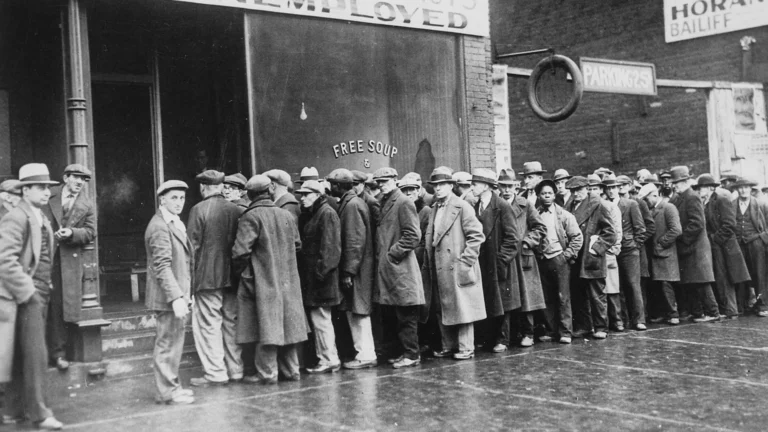
The worst economic downturn in U.S. history began with the 1929 stock market crash on the New York Stock Exchange. GDP fell by nearly 30%, and unemployment peaked at approximately 25%. Bank failures and a collapsing money supply intensified the crisis.
The federal government responded with the New Deal, establishing the Federal Deposit Insurance Corporation (FDIC) to protect depositors. This period teaches you the profound social and economic consequences of financial market collapses and the role of government intervention.
The Great Depression remains the worst economic downturn in U.S. history.
This brief but notable recession followed the sudden drop in government spending as the U.S. transitioned from wartime to peacetime. GDP growth contracted sharply in the fourth quarter of 1945, and unemployment rose as industries adjusted.
The lesson here is how shifts in fiscal policy and economic expansion impact employment and production.
Triggered by a decline in government spending and consumer demand, this mild recession saw GDP fall and unemployment rise to nearly 6%. Monetary tightening by the Federal Reserve to combat inflation played a role.
The inflation rate rose during this period, driven by wartime expenditures and postwar adjustments, which contributed to inflationary pressures.
For you, it highlights the delicate balance between fiscal policy and monetary measures in managing economic cycles.
This recession was shaped by the energy crisis, triggered by OPEC’s oil embargo, which caused oil prices to quadruple. The U.S. economy struggled with stagflation, a rare combination of stagnant growth and high inflation. Unemployment peaked at 9%.
This episode illustrates how external shocks like energy prices can cause profound economic pain and disrupt business sectors, including manufacturing and housing.
In an aggressive effort to fight inflation, the Federal Reserve, under Chair Paul Volcker, raised interest rates to nearly 20%. This led to a sharp contraction in industrial production and the housing sector, with unemployment reaching 10.8%.
Though painful, this policy was instrumental in breaking the back of persistent inflation. The takeaway for you is that sometimes short-term economic pain is necessary to restore long-term stability.
Caused by rising oil prices during the Gulf War and a slump in consumer confidence, this recession saw GDP decline and unemployment spike. Tightened lending hurt the banking and real estate sectors.
This event demonstrates how geopolitical conflicts and energy prices can ripple through the economy, affecting multiple industries and your investment decisions.
The 2001 recession was often called a mild recession and lasted from March to November. Following the bursting of the dot-com bubble and exacerbated by the September 11 attacks on the World Trade Center, this mild recession saw a dip in GDP and rising unemployment. The Federal Reserve responded by cutting interest rates to stimulate growth.
For you, it’s a reminder of how market exuberance and unexpected shocks can combine to derail economic progress.
The Great Recession sparked by the collapse of the housing bubble and a resulting credit crisis, this recession saw major financial institutions fail, unemployment peak at 10%, and GDP fall by over 4%. The Federal Reserve and federal government intervened with sweeping monetary and fiscal policies.
The average recession before 2007 lasted about 11 months, while the Great Recession lasted 18 months.
This crisis underscores the interconnectedness of housing markets, financial institutions, and the broader economy.
The shortest recession on record, lasting just two months, it nonetheless caused the steepest GDP contraction in the second quarter of 2020 and the highest unemployment rate since the Great Depression. Prompted by lockdowns and a sudden halt in economic activity, aggressive federal spending and monetary interventions helped stabilize the economy.
This episode highlights the speed and scale at which external shocks can impact the economy and the critical role of government and central banks in crisis response.
Historical recessions teach you that economic downturns are inevitable but vary widely in cause, duration, and severity. They reveal the importance of:
As history shows, recessions are complex phenomena influenced by financial markets, policy decisions, and external shocks. By studying the 10 worst recessions in U.S. history, you gain a framework to anticipate challenges and identify opportunities.
The key is not to fear recessions but to prepare strategically, balancing risk management with readiness to act decisively when economic expansions resume. Your resilience in the face of economic downturns will define your long-term success.
Recessions are typically caused by a combination of factors, including financial crises, rising interest rates, declining consumer demand, external shocks like oil price spikes, and policy missteps. These factors disrupt economic activity, leading to declines in GDP and employment.
The average recession in the U.S. since 1857 has lasted about 17 months. However, durations vary significantly, from just two months during the COVID-19 recession to several years during the Great Depression.
Unemployment tends to rise during recessions as businesses cut back on production and hiring. Notably, unemployment often peaks after the recession officially ends, as companies cautiously ramp up operations.
Through economic analysis, economists monitor indicators like GDP, employment, and consumer confidence to track and forecast recession trends. However, predicting recessions with precision is challenging due to complex and interrelated causes. Awareness of economic signals can help you prepare but not forecast exact timing.
The Federal Reserve Bank, as the institution responsible for implementing monetary policy during recessions, uses tools such as adjusting the fed funds rate to manage inflation and stimulate economic growth. During recessions, it often lowers interest rates to encourage borrowing and investment, helping to stabilize the economy.
Some of the worst recessions in U.S. history include the Great Depression (1929–late 1930s), the Great Recession (2007–2009), the 1973–1975 energy crisis recession, and the COVID-19 recession of 2020. These recessions were marked by significant GDP contraction, high unemployment, and widespread economic disruption.
The Great Depression, beginning with the 1929 stock market crash, is widely considered the worst recession in U.S. history. It caused a nearly 30% drop in GDP and unemployment rates that peaked around 25%, with long-lasting social and economic impacts.
Since 1857, the U.S. has experienced 34 recessions as identified by the National Bureau of Economic Research. Since the Great Depression, there have been 14 official recessions, varying in length and severity.
While political leadership can influence economic policy, attributing recessions solely to one party is an oversimplification. Economic downturns result from complex factors including global events, monetary policy, and market dynamics, transcending party lines.