Newsletter Subscribe
Enter your email address below and subscribe to our newsletter
Enter your email address below and subscribe to our newsletter


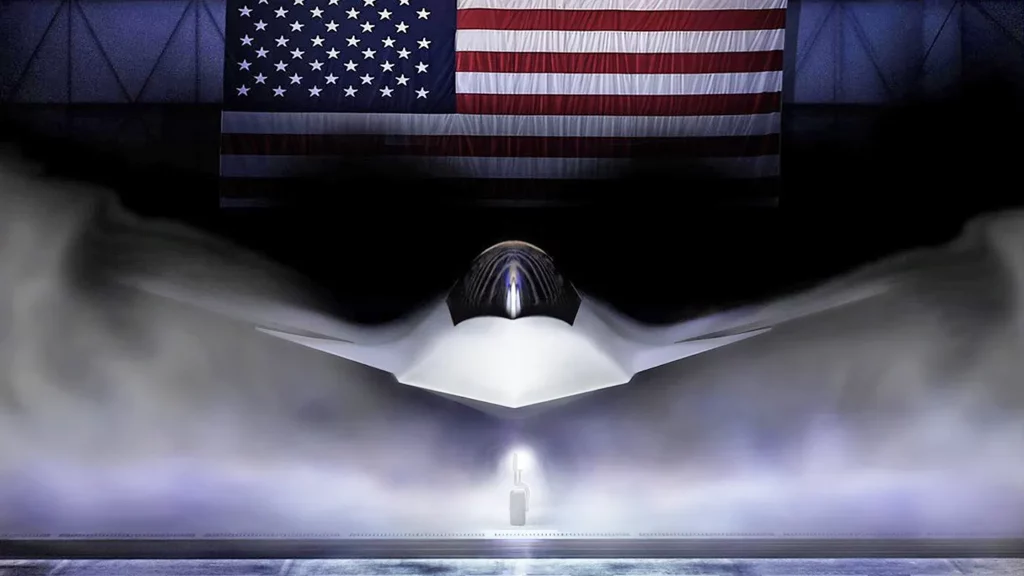
US unveils sixth-gen F-47 fighter jet with drone command tech, symbolizing Trump-era military resurgence.
 Tumisang Bogwasi Tumisang Bogwasi
In a landmark announcement from the Oval Office, President Donald Trump and Defense Secretary Pete Hegseth introduced the F-47, the United States’ first sixth-generation fighter jet and the crown jewel of the Next Generation Air Dominance (NGAD) initiative.
Built to surpass its predecessor, the F-35, the F-47 symbolizes not only the cutting edge of American aerospace technology but also a renewed emphasis on military dominance in an increasingly contested global arena.
President Trump emphasized that the F-47 would “fly with many, many drones,” signaling the U.S. military’s next leap into integrated manned-unmanned teaming (MUM-T). The aircraft is built to serve as a command hub for autonomous systems, enabling high-speed, coordinated attacks that penetrate even the most advanced air defenses.
“It flies with many drones, as many as you want… And that’s something no other plane can do,” Trump stated.
Though operational specifics remain classified, the F-47 is designed to house a pilot and operate as a force multiplier through drone swarms, giving it the edge in future conflicts with peer adversaries such as China.
The unveiling of the F-47 comes amid growing concerns over China’s military expansion and near-peer competition in the Indo-Pacific. With China fielding new stealth aircraft and hypersonic weapons, the U.S. has fast-tracked NGAD to maintain air superiority.
“Air dominance is not a birthright,” said Air Force Chief of Staff David Allvin. “It needs to be earned every single day.”
While some experts argue that the F-47 duplicates capabilities in development for the B-21 Raider stealth bomber, the Department of Defense sees the F-47 as a “quarterback” platform, coordinating an entire digital fleet from the air.

Critics have raised concerns over the F-47’s cost, especially given the Pentagon’s ongoing struggle to manage the $1.7 trillion lifecycle of the F-35 program. Production for the Air Force variant alone is expected to cost $20 billion, with Navy and Marine versions in competitive development.
Boeing will manufacture the F-47 from its Washington-based facilities, further supporting U.S. industrial jobs and technological leadership.
Secretary Hegseth defended the program, stating it would “revive the warrior ethos inside our military” and rejected claims that the previous administration had properly funded it.
The F-47’s designation carries symbolic weight. Though Trump claimed the naming was made by generals, the “47” not-so-subtly mirrors his second term as the 47th president. Hegseth reinforced this symbolism:
“We’ve had the F-15, F-16, F-18, F-22, and F-35. Now we have the F-47 — a message to our allies that we’re not going anywhere, and to our enemies that we will project power unimpeded.”
The F-47 rollout is part of Trump’s broader strategy to rebuild American military might and deepen domestic industrial investment in the defense sector.
With prototype flights reportedly underway since 2020, the F-47 is the centerpiece of the U.S. response to evolving global threats. From its AI-guided systems to drone coordination capabilities, the jet is built for speed, stealth, and digital supremacy.
“The F-47 is the crown jewel of our air-dominant future,” said Allvin. “It clears the skies and keeps the promise of American air power alive.”
The Air Force is expected to begin deployments by the late 2020s. While the full production schedule and deployment strategy remain classified, Pentagon insiders say the F-47 will reshape the battlefield from above.

With the announcement of the F-47, the United States reaffirms its strategic edge in global aerospace defense. As adversaries scale their military capabilities, the F-47 serves both as a technological leap and a political signal: American air dominance is not only alive but entering a new era.